
Contents
Temperature is one of those factors that people either underestimate or try to control too precisely.
Some people work “by eye” and pay no attention to it, while others, on the contrary, are afraid to deviate from the target figure by even a few degrees. But the problem isn’t whether the temperature is “important or unimportant.” It is often viewed as a mere number rather than part of the process – and that is precisely what causes most of the difficulties.
As a result, there are situations where the cream looks fine right after it’s made, but behaves differently just a few days later. This is often when the question arises: why does the cream separate, even though the ingredients haven’t changed?
👉 If you’ve already encountered this, it’s worth taking a closer look: why does the cream separate, and what happens to the formula?
Temperature isn’t just about degrees
In cosmetics manufacturing, temperature almost never acts on its own. It affects how ingredients dissolve, how the emulsifier behaves, how the structure forms, and how the system as a whole “comes together” into a stable product.
In other words, temperature is not a standalone parameter, but rather a condition under which the formula is formed. That is why two identical recipes can yield different results: the ingredients are the same, but the process unfolds differently.
👉 This is directly related to the fact that you think in terms of a formula rather than a recipe – the article explains in detail how a cosmetic formula is created and what factors influence the result
Where temperature is truly critical
There are stages where temperature doesn’t just influence the outcome – it determines it.
1. Phase connection
This is the moment when the emulsion forms. If the phases are close in temperature, the system forms a stable emulsion. If, however, there is a significant temperature difference, the structure turns out to be weak, even if this isn’t immediately apparent from the outside.
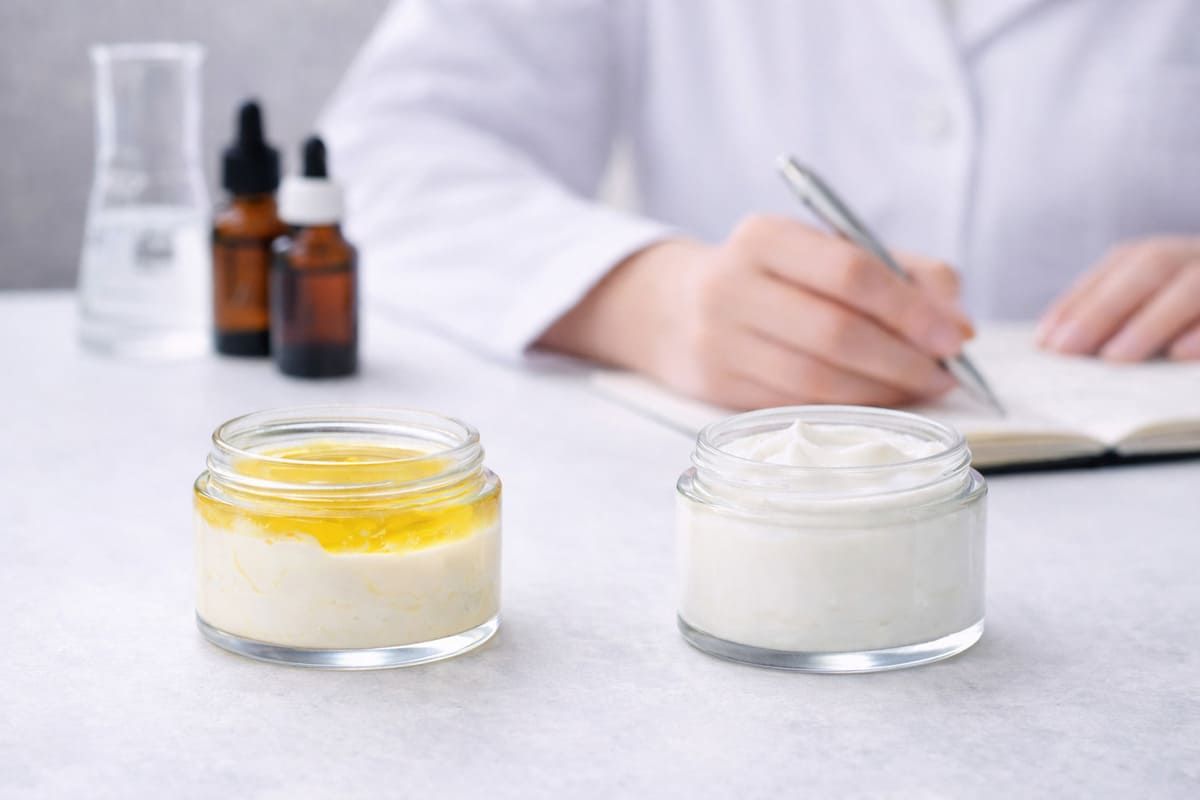
A typical scenario goes like this: the cream has a good texture right after it’s made, but after a few days, a watery layer forms or the consistency changes. In such cases, the problem is often not the ingredients, but rather that one of the phases has already cooled down or the process itself has taken too long.
2. How an emulsifier works
An emulsifier isn’t simply “added” – it must reach a certain state to begin working properly. If the temperature is too low, it won’t fully activate, and the resulting structure will be weak.
That is why a cream may look fine right after it is made, but may not hold its shape or may change over time. This is one of the common scenarios where a cosmetic product’s stability is compromised, even though the formulation seems correct.
3. Cooling
Cooling is often seen as the final step in the process, but in fact, it is at this very moment that the final structure is formed.
Two identical recipes can yield different results simply because, in one case, the cream was stirred while cooling, while in the other it was left undisturbed. The method of cooling – whether gradual or rapid – also has an impact.
On the surface, it may look the same, but over time the difference becomes clear.
Where temperature is not a critical factor
A difference of a few degrees rarely affects the result on its own. Problems arise not because of 72°C or 74°C, but because of disruptions in the process - when phases are out of sync or the stage itself is not proceeding correctly.

The same applies to introducing assets within the permissible temperature range. A slight deviation is usually not critical if the system has already been set up correctly.
Why does the same formula produce different results?
This is one of the most common situations, and it raises the most questions.
The recipe hasn’t changed. The ingredients are the same. But the result is different.
For example, sometimes the process goes quickly, and the phases combine at similar temperatures – the cream is stable. Other times, the process takes longer, one of the phases has time to cool – A difference of a few degrees rarely affects the result on its own. Problems arise not because of 72°C or 74°C, but because of disruptions in the process – when phases are out of sync or the stage itself is not proceeding correctly.
The same applies to introducing assets within the permissible temperature range. A slight deviation is usually not critical if the system has already been set up correctly. A difference of a few degrees rarely affects the result on its own. Problems arise not because of 72°C or 74°C, but because of disruptions in the process – when phases are out of sync or the stage itself is not proceeding correctly.
The same applies to introducing assets within the permissible temperature range. A slight deviation is usually not critical if the system has already been set up correctly.and the structure forms differently.
At times like these, it seems as though the problem lies in the formula. In reality, however, it is the conditions under which it is applied that are changing.
How to manage a fever without complications
To achieve consistent results, you don’t need to monitor every single degree. It’s enough to pay attention to the key factors: whether the temperatures of the phases are close at the moment of mixing, whether the emulsifier has reached its optimal working state, and how the cooling process proceeds.
It is precisely these factors that most often determine whether the outcome will be predictable.
The finishing touch
When it comes to cosmetics manufacturing, temperature isn’t about exact numbers. It’s about the conditions under which the product’s structure forms and how the process itself unfolds.
Once this becomes clear, the approach changes. The need to search for the “perfect temperature” disappears, and the ability to see exactly what is happening in the formula emerges.
And if you want to do more than just experiment – if you really want to understand how temperature works at each stage and how it affects stability – you’ll grasp it much faster through systematic learning.
👉 See how the cosmetics-making course works and get a deeper understanding of the processes
Comments (0)