
Contents:
When a cream changes texture a few days or weeks after being made, it’s almost always cause for concern. Especially if everything looked fine right after it was made: the consistency was smooth, the texture was pleasant, and the product itself seemed stable.
At times like these, it often feels as though the formula has “gone bad” or that a critical mistake was made somewhere. This is especially true when the cream starts behaving differently not only in the jar but also on the skin: it spreads less smoothly, as if it’s “empty” and slippery, becomes more watery, or, conversely, too thick.
But in practice, a change in texture doesn’t always indicate a problem. Some of the processes in the cream continue even after production is complete—and that’s the key point to understand.
The texture of a cosmetic product is not completely “set” the moment the cream is placed in the jar. The formula continues to stabilize for some time: the ingredients continue to interact with one another, the structure becomes denser, and the system gradually reaches its final state.
That is precisely why it is important to pay attention not only to the fact that the texture is changing, but also to exactly how it is changing and what is happening to the formula at that moment.
Why doesn’t the cream’s texture set completely right after it’s made?
One of the most common misconceptions is to judge the cream immediately after making it, as if it were already the final product.
In practice, many emulsions continue to change over the next 24 to 48 hours. During this period, their structure is still stabilizing: their density, viscosity, and texture may change.
For example, a cream may seem thinner immediately after cooling, but it becomes thicker and firmer after a day. Conversely, a product that initially seemed stable may, over time, begin to lose its firmness or become less uniform in texture.
It is precisely this point that often leads to misunderstandings. People tend to think that the formula has “broken down,” when in fact the system simply hasn’t finished stabilizing yet.
For this reason, a professional evaluation of the cream is almost never conducted immediately after it is made. Sometimes what appears to be a problem in the first few hours develops into a normal, stable texture after a day.
👉 Texture is not a static parameter, but rather the system's behavior over time.What changes in skin texture are considered normal?
Not every change in texture means that the formula is unstable.
In many cases, the following is considered normal:
- a slight change in density;
- slight thickening after stabilization;
- a less “airy” texture;
- a change in the sensation of gliding across the skin.
This is particularly noticeable in creams, where the texture develops gradually as the emulsion cools and stabilizes.
For example, a cream may initially seem very light and malleable, but after a day it may become denser and firmer. Or it may no longer look as “fluffy” as it did immediately after being whipped or vigorously stirred.
And that’s normal. The formula is, so to speak, being “refined” within the system itself.
That is precisely why assessing the texture immediately after production very often gives a false impression of the cream’s actual condition.
Not all changes in texture indicate instability. In many cases, the cream continues to stabilize after it has been made, and this is what affects its behavior in the first few days.When a change in texture is already a sign of a problem
There are changes that are no longer related to system stabilization but indicate an imbalance in the formula.
Most often, these are:
- the onset of watery discharge;
- a sudden drop in pressure;
- grain size;
- a stringy or “slippery” texture;
- loss of uniformity;
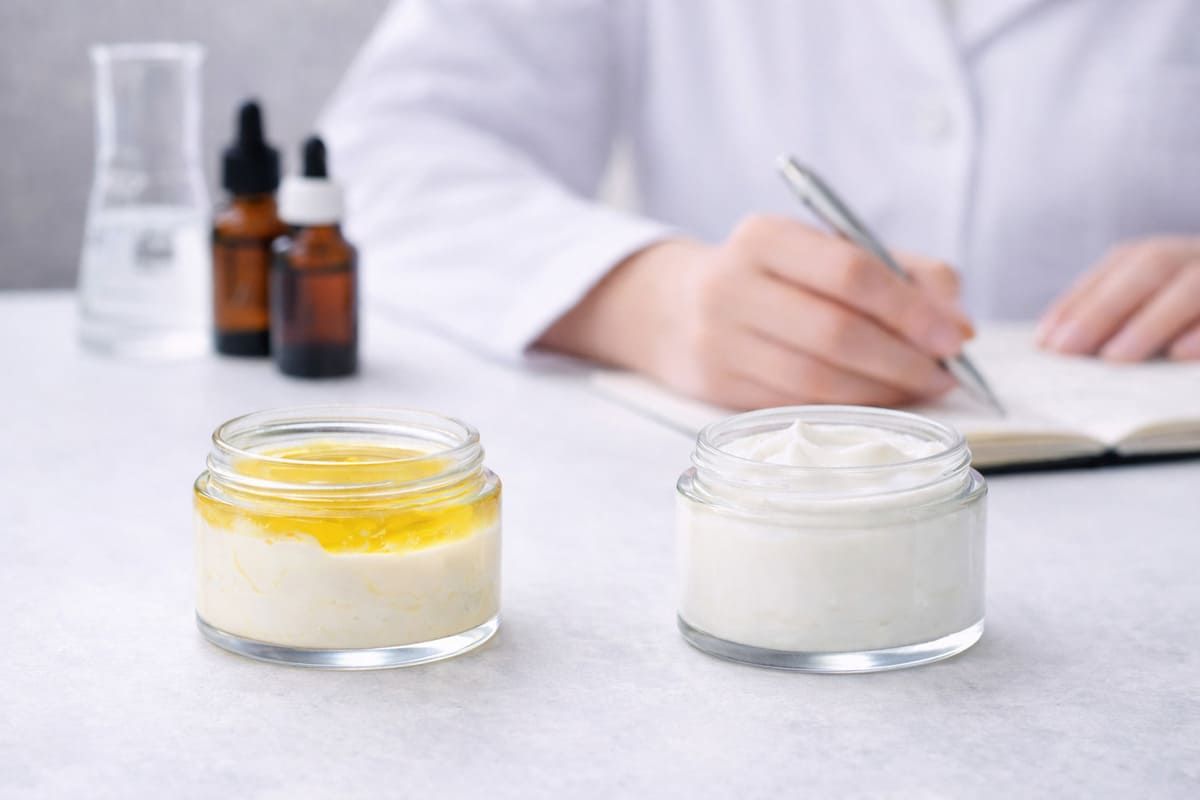
- phase separation.
Sometimes this isn’t immediately apparent, but becomes evident when you apply it. The cream may look fine in the jar, but once on the skin, it might start to “stretch” between your fingers, spread unevenly, or feel as though its texture has become thin and unstable.
In such cases, the problem usually lies not in the texture itself, but in the fact that the system can no longer maintain its structure consistently.
For example, a cream may remain thick but behave like a liquid when it comes into contact with the skin. Or, conversely, it may appear stable on the outside but gradually lose its texture inside the jar.
That is precisely why texture is not just a “feeling of cream,” but one of the most important indicators of what is happening within the formula.
If these changes result in a loss of uniformity or separation, that is a separate topic for discussion. For more on this, see the article “Why Cream Separates: How to Tell What’s Happening to the Formula.”What affects the texture and stability of the cream
The texture of the cream is influenced not by a single factor, but by a combination of processes that make up the system.
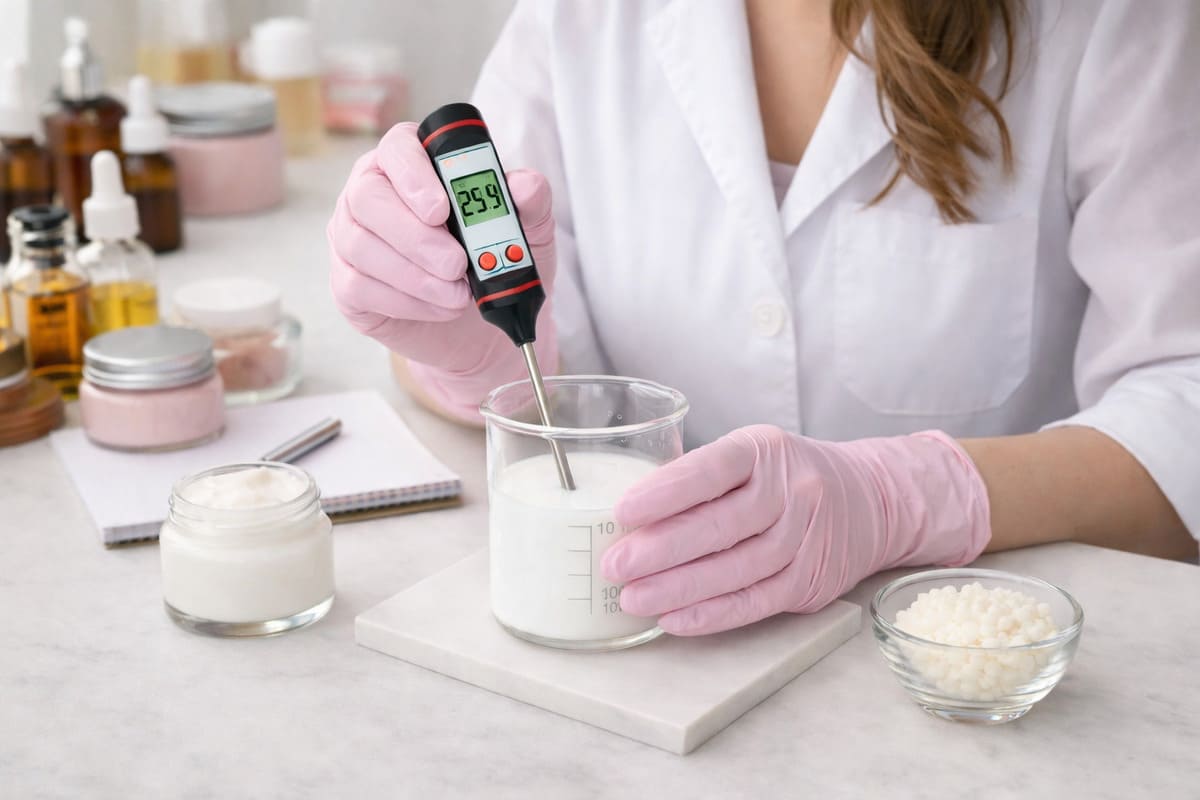
One of the key factors is temperature. It is temperature that influences the behavior of the emulsifier, the formation of interphase bonds, and the subsequent stabilization of the structure.
For example, a cream may look perfectly normal on the day it is made, but after a few days it may lose its stability simply because one of the phases was not heated sufficiently or was cooled too rapidly.
The cooling process itself is just as important. Two identical mixtures may behave differently depending on how this stage was carried out: gradually or abruptly, with or without stirring.
The texture is also influenced by:
- overloading the formula with assets;
- phase imbalance;
- characteristics of the emulsifier;
- stabilization period.
All of this works not in isolation, but as a single system. That is precisely why two identical recipes sometimes yield different results.
👉 For more information on the role of temperature in emulsion stability, see the article “Temperature in Cosmetics Manufacturing: When It Matters and When It Doesn’t”.Why the same formula can behave differently
This is one of the most common situations in cosmetics manufacturing.
The recipe remains the same, the ingredients haven’t changed, but one batch turns out consistently, while the other doesn’t.
In practice, this is often due not to the ingredients, but to the process itself:
- with different phase temperatures;
- operating speed;
- cooling type;
- the time between stages.
Sometimes even a difference of just a few minutes between stages can affect how the system develops from there.
That is precisely why the stability of the cream and the formula as a whole depends not only on the ingredients, but also on how this system was implemented in practice.
How to properly assess the texture of a cream
It’s not a good idea to assess the texture immediately after production. At that point, the system hasn’t fully stabilized yet, and some of its properties may still change.
The following observation is far more revealing:
- in 24 hours;
- in a few days;
- after the structure has stabilized.
That is when it becomes clear how the formula performs under real-world conditions, rather than just at the time of manufacture.
And this is exactly where many people have their first “aha moment”: a cream’s texture can change not because the formula is “bad,” but because the system hasn’t fully developed yet.
Key Points
Yes. In many cases, the emulsion’s structure does not stabilize immediately after preparation, but rather over the next 24 to 48 hours.
Not always. Some changes are simply a normal stabilization of the mixture. However, watery consistency, graininess, or separation are already signs of an imbalance in the system.
This is because the result is influenced not only by the composition, but also by the process itself: temperature, cooling, operating speed, and the conditions under which the emulsion forms.
Not immediately after production, but after the formula has stabilized—usually after 24–48 hours.
The finishing touch
A cream’s texture is more than just a superficial characteristic of the product. It is one of the most accurate indicators of how stable the formula itself is.
Sometimes a cream changes texture not because the formula is “bad,” but because the system hasn’t fully set yet. This is often the moment when you start to view cosmetics not as a recipe, but as a process.
And once this becomes clear, the very approach to cosmetics manufacturing changes. Instead of trying to “fix the texture,” there’s a desire to understand exactly what’s happening within the system and why the formula behaves the way it does.
It is at this very moment that the process ceases to be random and becomes a conscious one.
👉 If you want to do more than just follow recipes if you want to truly understand how emulsions work, as well as the stability and structure of creams — systematic training will help you get there much faster and with greater confidence.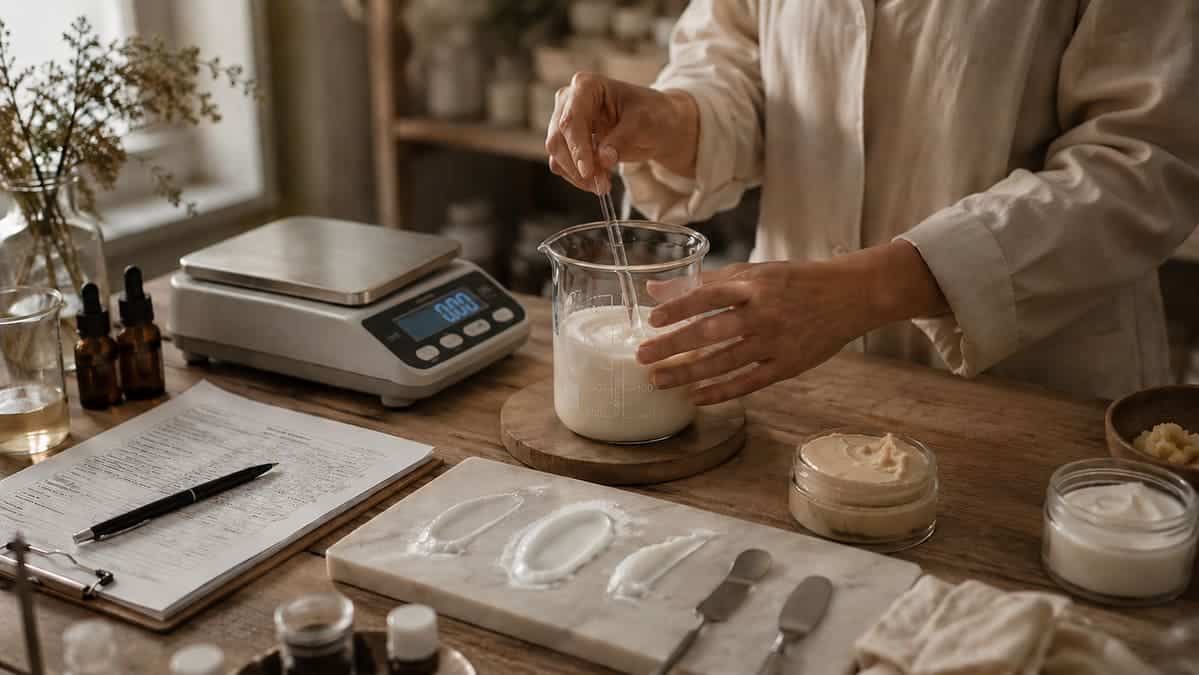
Comments (0)